Here is a simple application of the law of iterated expectations.
We revisit the stick-breaking example, which we have seen sometime in the past.
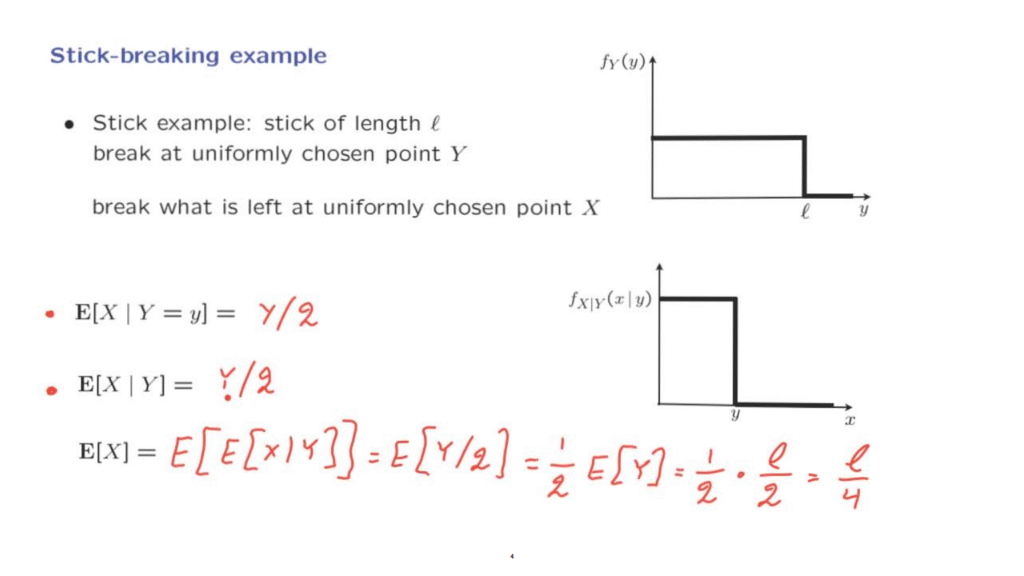
So in this example, we start with a stick that has a certain length and which we break at a point that’s chosen uniformly at random throughout the length of the stick.
And we call the point at which we cut the stick capital Y.
So the random variable Y has a uniform distribution on the interval from 0 to l, and is described by this particular PDF.
Then we take the piece of the stick that’s left and we break it at a point that’s chosen uniformly over the length of the stick that’s left.
So the stick that was left has a length Y, and the place at which we cut it, X, is chosen uniformly over that interval.
So in particular, X– or rather the conditional distribution of X given Y– is uniform on that interval.
So in this example, what is the expected value of X if I tell you the value of Y?
Well, given the value of Y, the random variable X is uniform on that range.
So the expected value is going to be at the midpoint that is equal to y over 2.
This is an equality between numbers.
For any particular number, little y, we have this equality.
Now let us convert this concrete equality between numbers to a more abstract equality between random variables.
This object is a random variable that takes this value whenever capital Y is little y.
So this is an object that takes the value little y over 2 whenever the random variable capital Y happens to be little y.
But that’s the same as the random variable capital Y over 2.
This is a random variable that takes this value whenever capital Y happens to be the same as little y.
So the conditional expectation– the abstract conditional expectation is a random variable because its value is determined by the random variable capital Y, and it is this particular function of the random variable capital Y.
And now we can proceed and calculate the expected value of X using the law of iterated expectations.
The law of iterated expectations takes this form.
We have already calculated what this random variable is.
It is the random variable that’s equal to Y over 2.
So this is the same as 1/2 the expected value of Y.
And since Y is uniform in the range from 0 to l, the expected value of Y is equal to l over 2, which gives us an answer of l over 4.
This is the same as the answer that we got in the past where we actually found it using the total expectation theorem.
The calculations were exactly the same as what went on here except that here we carry out the calculation in a more abstract form.
And what is important to appreciate from this example is the distinction between these two lines.
This is an equality between numbers, which is true for any specific little y.
Whereas this is an equality between random variables.
This quantity is random and this quantity is also random, meaning that their values are not known until the experiment is carried out and the specific value of capital Y is realized.