We will now go through an example, which is essentially a drill, to consolidate our understanding of the conditional expectation and the conditional variance.
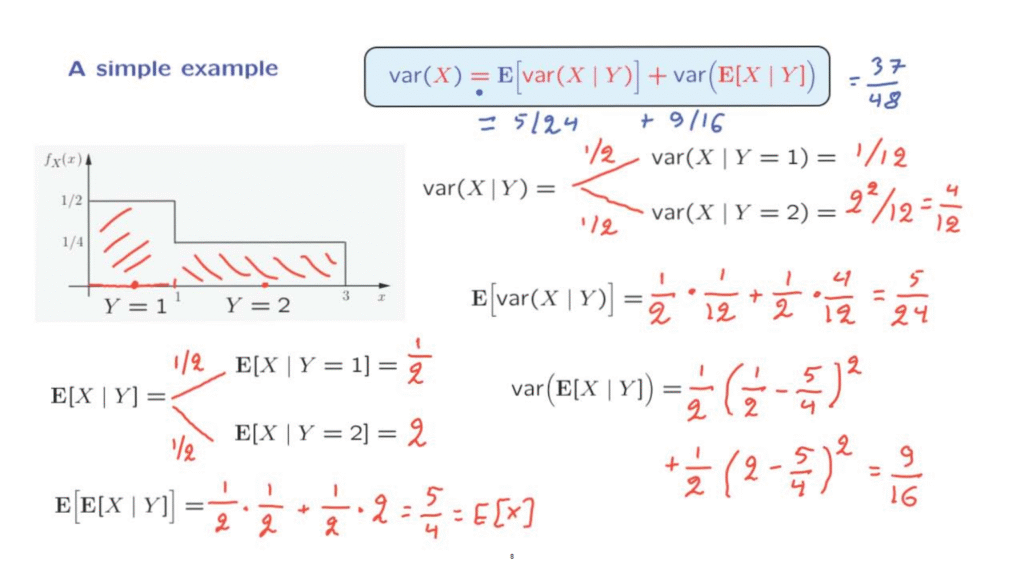
Consider a random variable X, which is continuous and is described by a PDF of this form.
Whenever we have a PDF that seems to consist of different pieces, it’s always useful to divide and conquer.
And the way we will do that will be to consider two different scenarios.
That X falls in this range.
And in that scenario, we say that the certain random variable Y is equal to 1.
And another scenario in which X falls in this range, and in that case, we say that Y is equal to 2.
Let us now look at the conditional expectation of X given Y.
What is it?
Well, it is a random variable which can take a different values depending on what Y is.
If Y happens to take a value of 1, then we are in this range.
And the conditional PDF of X, given that Y falls in this range, keeps the same shape, it’s uniform.
And so it’s mean is going to be equal to the midpoint of this interval, which is 1/2.
And this is something that happens when Y is equal to 1.
What is the probability of this happening?
The probability that Y is equal to 1 is the area under the PDF in this range.
And since the height of the PDF is 1/2, this probability is 1/2.
The alternative scenario is that Y happens to take the value of 2.
In which case, X lives in this interval.
Given that X has fallen in this interval, the conditional expectation of X is the midpoint of this interval.
And the midpoint of this interval is at 2.
And this is an event that, again, happens with probability 1/2, because the area under the PDF in this region is equal to 1/2.
So the conditional expectation is a random variable that takes these values with these probabilities.
Since we now have a complete probabilistic description of this random variable, we’re able to calculate the expectation of this random variable.
What is it?
With probability 1/2, the random variable takes the value of 1/2.
And with probability 1/2, it takes a value of 2.
And so the expected value of the conditional expectation is 5/4.
But the law of iterated expectations tells us that this quantity is also the same as the expected value of X.
So we have managed to find the expected value of X by the divide and conquer method, by considering different cases.
Let us now turn to the conditional variance of X given Y.
Once more, this quantity is a random variable.
The value of that quantity depends on what Y turns out to be.
And we have, again, the same two possibilities.
Y could be equal to 1, or Y could be equal to 2.
And these possibilities happen with equal probabilities.
If Y is equal to 1, conditional on that event, X has a uniform PDF on this range, on an interval of length one.
And we know that the variance of a uniform PDF on an interval of length one is 1/12.
If on the other hand, Y takes a value of 2, then X is a uniform random variable on an interval of length 2.
And the variance in this case is 2 squared, where this 2 stands for the length of the interval, divided by 12, which is the same as 4/12.
So we now have a complete probabilistic description of the conditional variance as a random variable.
It’s a random variable that with these probabilities, takes these two particular values.
Since we know the distribution of this random variable, we can certainly calculate its expected value.
And the expected value is found as follows.
With probability 1/2, the random variable of interest takes a value of 1/12.
And with probability 1/2, this random variable takes a value of 4/12.
And this number happens to be 5/24.
Finally, let us calculate the variance of the conditional expectation.
Since we have complete information about the distribution of the conditional expectation, calculating its variance is not going to be difficult.
So what is it?
With probability 1/2, the conditional expectation takes a value of 1/2.
We subtract from this is the mean of the conditional expectation, which is 5/4.
And we take the square of that.
So this term is the square or the deviation of the value of the random variable of 1/2 from the mean of that random variable.
And we get a similar term.
If Y happens to be equal to 2.
With probability 1/2 half, our random variable takes a value of 2, which is so much away from the mean of the random variable.
And then we square that quantity.
If we carry out the algebra, the answer turns out to be 9 over 16.
And now we can go back to the law of the total variance and calculate that the total variance is equal to the expected value of the variance, which is 5/24.
And then we have the variance of the expected value, which is 9/16.
And this number evaluates to 37/48.
So we have managed to find the variance of this random variable using the divide and conquer methods and the law of the total variance.