We will now go through a derivation of the law of total variance.
This particular derivation is not insightful.
It will not really give you any intuition as to why the law of total variance is correct.
On the other hand, it involves some interesting manipulations that will be useful to be able to follow, and understand the kinds of objects that they’re being moved around, and why each step is valid.
Our derivation relies on the standard formula that we have on how to calculate variances.
And our first step is to apply this formula to the conditional variance.
Now, the conditional variance is like an ordinary variance, except that it is calculated in a conditional universe.
So we apply this formula, except that the expectation of X squared is the expectation calculated in the conditional universe.
And similarly, for the next term it is the square of the expected value of X.
But it’s the expected value of X as calculated in the conditional universe.
So this is an equality between numbers.
What does it translate to?
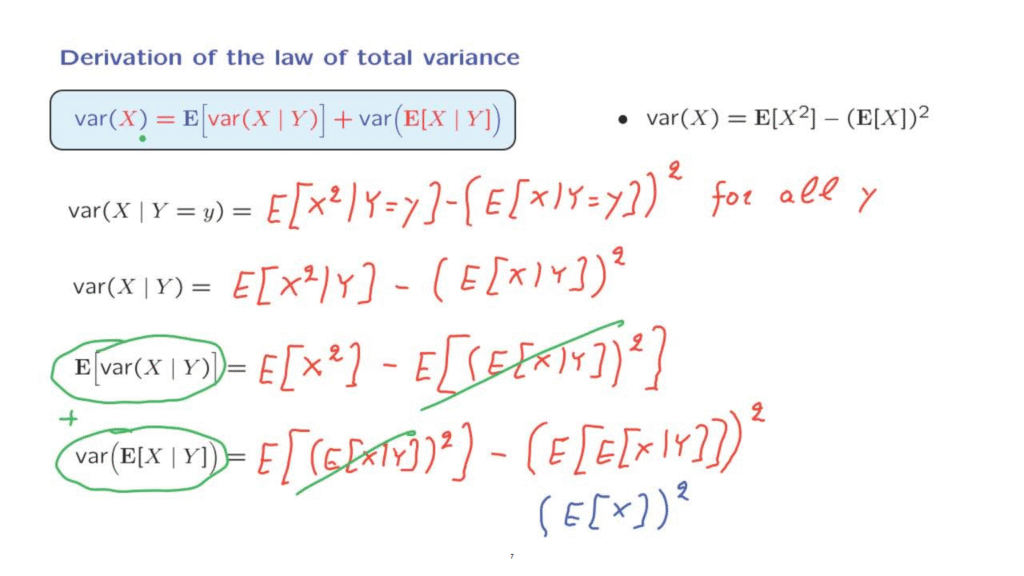
This has been defined as a random variable that takes this value when capital Y is equal to little y.
What is the random variable that takes this value when capital Y is little y?
Well, this random variable here is a random variable that takes this value when capital Y is equal to little y.
And this random variable here is a random variable that takes this numerical value when capital Y is equal to little y.
So to summarize, this is the random variable that takes this numerical value when capital Y is equal to little y.
And this is a random variable that takes this value when capital Y is equal to little y.
This expression, the left hand side is equal to the right hand side for all y’s.
And therefore, this random variable and that random variable always take the same numerical values no matter what y happens to be.
So these are identical random variables.
And so we have this equality between random variables.
The next step as we’re working towards calculating this first term here in the law of total variance is to take the expectation of this expression.
What is it?
We take the expectation of the first term.
It’s the expectation of a conditional expectation.
And according to the law of iterated expectations, it is the same as the unconditional expectation.
And then we have the expected value of the next term.
Next, we want to make some progress towards calculating this second quantity in the law of total variance.
And the way to calculate it is to just apply this general property of variances to the special case where X gets replaced by the expected value of X given Y.
So the first term will be the expected value of our random variable squared.
Our random variable is the expected value of X given Y.
And the second term involves the expected value of the random variable whose variance we’re considering.
So it’s the expected value of this random variable.
So it’s the expected value of the conditional expectation.
And everything gets squared.
What is this term?
By the law of iterated expectations, the expected value of a conditional expectation is the same as the unconditional expectation.
So this last term here is of this form.
What we will do next is to take this expression here and that expression here, and add them together.
When we add them, we notice that this term and that term are the same.
So they cancel out.
And we’re left with the expected value of X squared minus the square of the expected value.
But we know that this is the same as the variance of X.
So we have proved that the sum of these two terms, which are the two terms up here, give us the variance of X.