By this point in this class, you must have realized that a lot of revolves around the concept of conditioning.
Conditional expectations play a central role.
For this reason, it is useful to revisit this concept and view it in a more abstract manner.
The basic idea is that the value of a conditional expectation is affected by a random quantity by the value of the random variable Y on which we are conditioning.
It is a function of Y and, therefore, a random variable.
Based on this observation, we will redefine the conditional expectation as a random variable and then try to understand its properties.
In particular, we will develop a formula for the expected value of the conditional expectation.
This will be what as known as the law of iterated expectations.
After doing all this, we will follow a similar program for the conditional variance.
Once more, we will see that it can be viewed as a random variable.
And then we will relate its expected value with the unconditional variance.
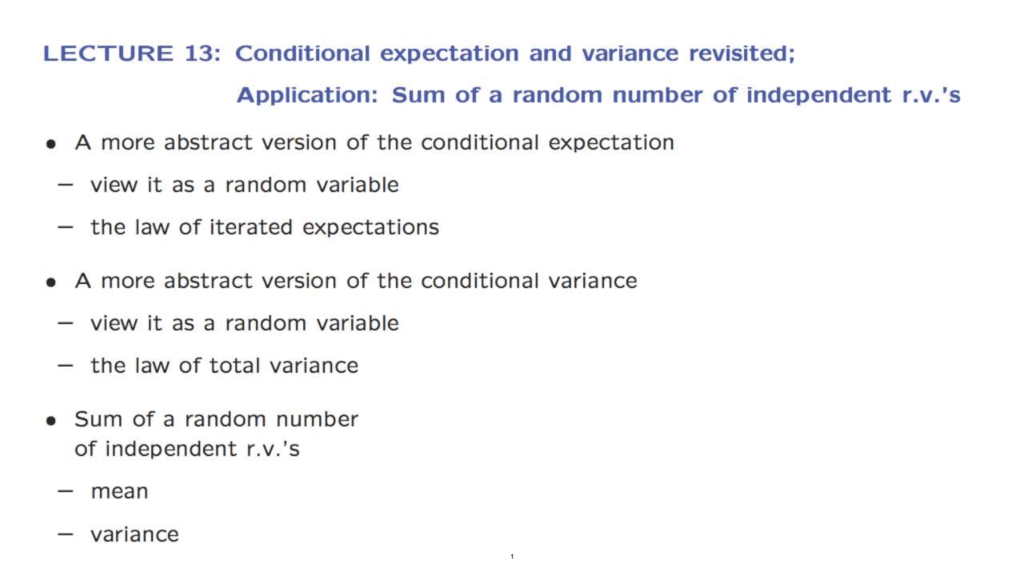
This will be the so-called law of total variance.
As an illustration of the tools we are introducing in this lecture, we will consider various examples that will hopefully clarify the concepts involved.
Our final and most important example will involve the sum of a random number of independent random variables.
The setting here is more challenging than the case where we add a fixed number of random variables.
But by using conditioning, we will be able to derive formulas for the mean and the variance.