In this brief segment, we will discuss an important application of the convolution formula.
Suppose that X is a normal random variable with a given mean and variance.
So that the PDF of X takes this form.
And similarly, Y is normal with a given mean and variance.
So its PDF takes this form.
We assume that X and Y are independent.
And we’re interested in the sum of the two random variables X and Y.
And we wish to derive the PDF of Z.
Of course, the PDF of Z is given by the convolution formula.
And now we plug in here, the form for the density of X.
And here, we plug the form of the density of Y.
Except that instead of the argument Y, we need to put in the argument z minus x.
So we obtain this form, where here we have a z minus x instead of y.
Now this is an integral that looks pretty complicated.
But it is not too hard to do.
One just needs to be patient, rearrange terms, collect terms.
And the details of the calculations are not as interesting.
So we will skip them for now.
And I will just tell you that the final answer takes this form.
What is this form?
Well, it’s exponential of minus z minus something squared divided by a constant.
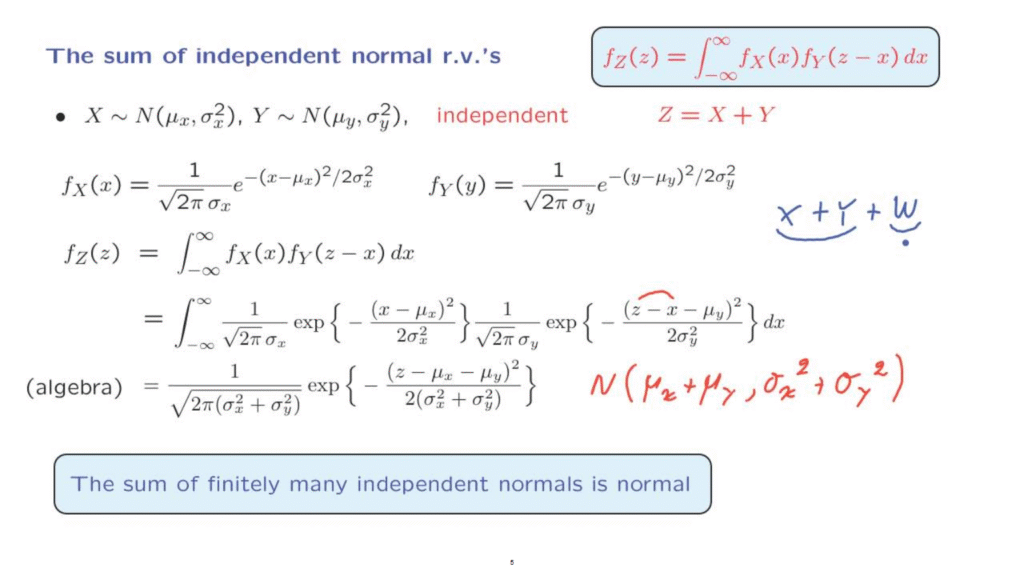
And we recognize that this is the form of a normal random variable.
It’s a normal random variable whose mean is given by this term here, it’s mu x plus mu y.
And the variance of that normal random variable is that constant that appears next to the factor of 2 in the denominator.
So the sum of these two normal random variables, these two independent normal random variables, is also normal.
The fact that this is the mean and this is the variance of the sum, of course, is not a surprise.
What is important in this result that we have here is that the sum is actually normal.
Now, we carried out this argument for the case of the sum of two normal random variables.
But suppose that we had the sum of three independent normal random variables, what can we say about it?
By the result that we just discussed, this sum is normal.
This is assumed to be normal.
We assume that X, Y, and W are independent.
Therefore, this sum is independent from W.
So we’re dealing with the sum of two independent normal random variables again.
So this sum here is going to be normal as well.
And we continue this argument by induction, and conclude that more generally, the sum of any finite number of independent normal random variables is normal.
This is a very important, but also useful fact.
It means that when we start working with normal random variables, very often we stay within the realm of normal random variables.
We can form linear functions of them, take linear combinations of them, and still remain in the world of normal random variables.