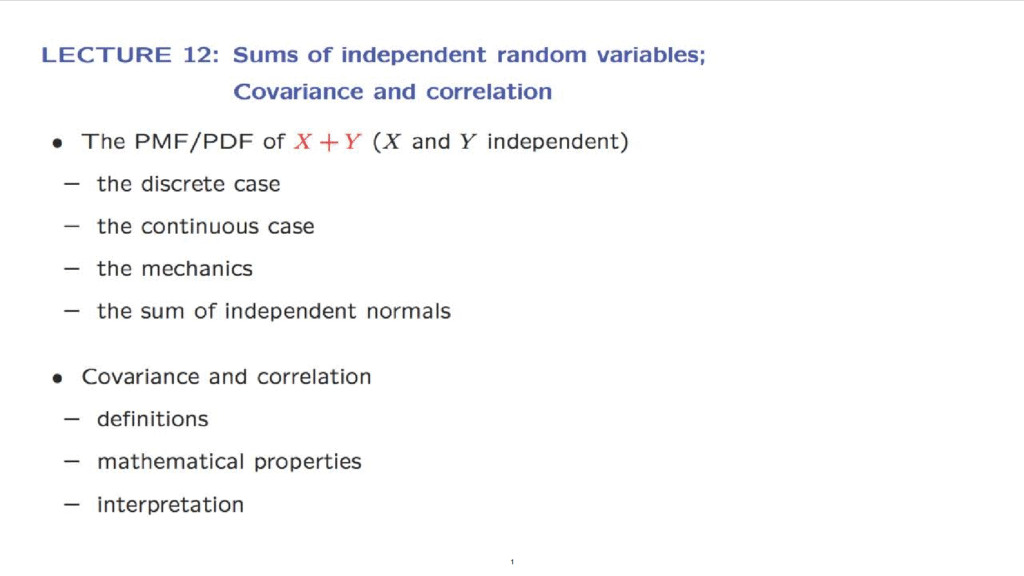
This lecture consists of two parts that deal with two rather different topics.
In the first part, we look into an important special case of a derived distribution problem.
We start with two independent random variables with known distributions and wish to find the distribution of their sum.
We will see that for either the discrete or the continuous case, there is a nice formula that gives us the answer.
We will develop this formula and then we will talk a little bit about a graphical way of carrying out the calculations involved.
As we will discuss, this formula also allows us to establish the very important fact that the sum of two independent, normal random variables is normal.
In the second part, we introduce the covariance of two random variables and the correlation coefficient.
These are certain quantities that allow us to quantify the degree to which two dependent random variables are related.
For example, a high value of the correlation coefficient will indicate a strong relation between these random variables.
We will see the basic mathematical properties of these quantities and provide some interpretation.
Later on in this class, we will see that they play an important role in the problem of estimating one random variable, given the value of another.