In this lecture, we will deal with a single topic.
How to find the distribution, that is, the PMF or PDF of a random variable that is defined as a function of one or more other random variables with known distributions.
Why is this useful?
Quite often, we construct a model by first defining some basic random variables.
These random variables usually have simple distributions and often they are independent.
But we may be interested in the distribution of some more complicated random variables that are defined in terms of our basic random variables.
In this lecture, we will develop systematic methods for the task at hand.
After going through a warm-up, the case of discrete random variables, we will see that there is a general, very systematic 2-step procedure that relies on cumulative distribution functions.
We will pay special attention to the easier case where we have a linear function of a single random variable.
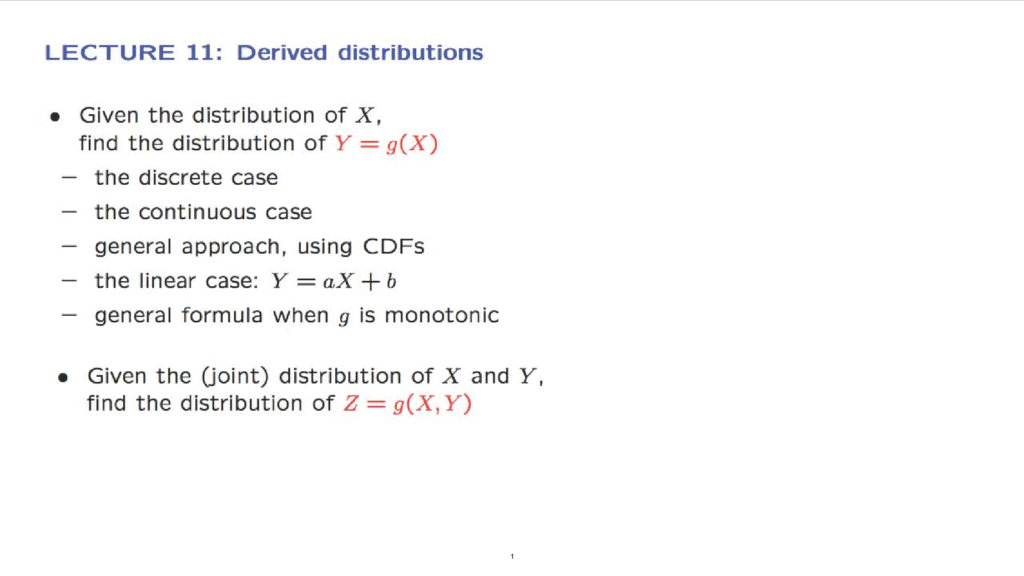
We will also see that when the function involved is monotonic, we can bypass CDFs and jump directly to a formula that is easy to apply.
We will also see an example involving a function of two random variables.
In such examples, the calculations may be more complicated but the basic approach based on CDFs is really the same.
Let me close with a final comment.
Finding the distribution of the function g of X is indeed possible, but we should only do it when we really need it.
If all we care about is the expected value of g of X we can just use the expected value rule.